“Can you define for us what is Artificial intelligence?”
The untold origins of artificial intelligence lie not in machines but in power, revealing the fantasies behind the hype that got us here and where we go next.
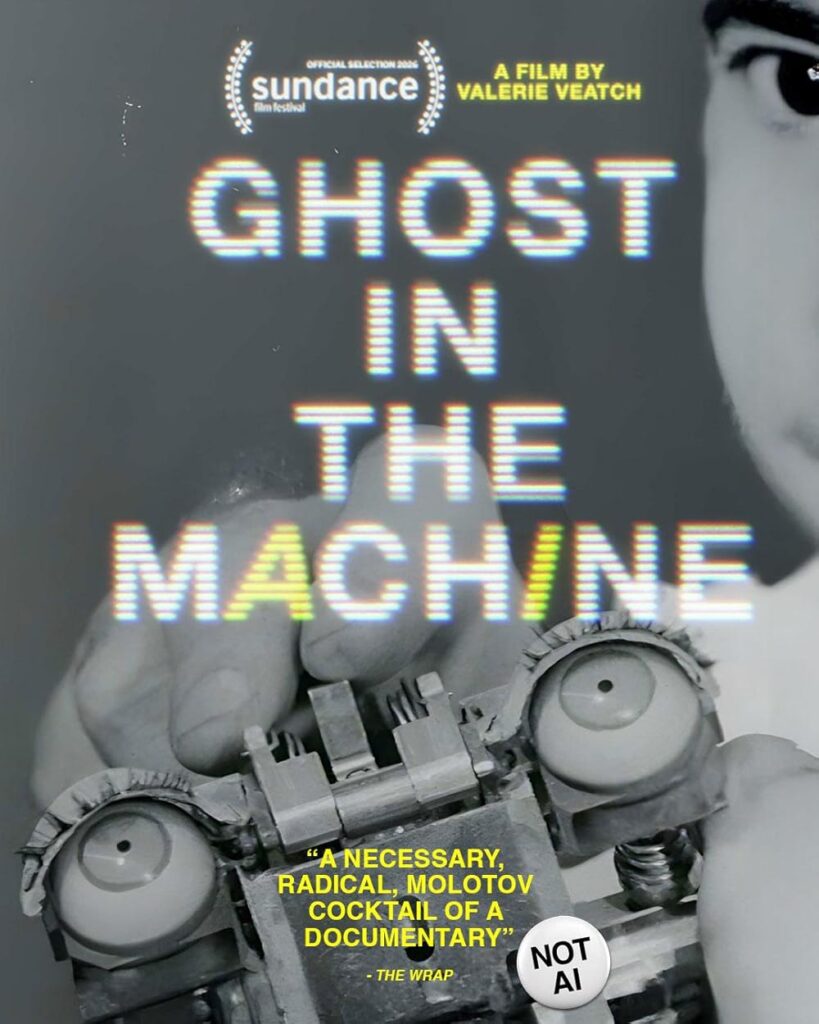
With Ghost in the Machine, Valerie Veatch offers an investigative documentary that explores how emerging technologies are redefining identity, culture, and global power.
Origins
Do you know when the term “artificial intelligence” was first used? Around the 2000s, right? Well, no. Much earlier, Professor John McCarthy used it as early as 1955, and later employed it to boost a research project and attract investors.
Ghost in the Machine spends a significant amount of time explaining the origins of this term. Obviously, it makes sense to understand the past to comprehend where we are going. It is therefore interesting to see how far the roots of this technological field reach.
On the other hand, too much time is spent there. At a certain point, one gets the impression that we won’t learn much about the state of the field in 2025. This is one of the film’s weak points. It remains too focused on the past. Yes, it is relevant and fascinating to see where the expression comes from and who contributed to advancing this field. But we would like to learn a little more… about what is happening right now.
Scare tactics
Valerie Veatch
In eight chapters, Veatch leads an exploration of the philosophical, cultural, and political forces underpinning the global rise of AI. Consciously, she attempts to frighten. As is too often the case, the emphasis is on dangers, excesses, and the negative. Elon Musk, Big Tech, billionaires, “bad men”… everything is there to remind us that we are but small humans facing the big bad wolves.
Ghost in the Machine is part of a movement bringing together people eager to challenge dominant narratives about the technologies we choose to develop, their reasons for being, and their beneficiaries. Obviously, questioning and challenging is important. But at times, one gets the impression that the documentary will fall into dubious conspiracy theories.
The movie feels much more like a pamphlet against AI than a real documentary. This is not a problem in itself, but it must be presented as such. Otherwise, it is dishonest. That is where my problem lies with Valerie Veatch’s film.
At one point, Dr. Johnathan Flowers says: “In the age of AI, the most radical thing we can do is ask this very simple question: do we need AI for this? And if you can’t answer yes, then refuse to use it. Repeatedly.”
Therein lies the main value behind this film.
A little more…
I have no problem with films that sell values or want to stir up ideas. However, the filmmakers who create them must do so honestly. Don’t talk about a documentary on a specific subject when, in fact, you are offering a pamphlet on that subject.
One of the elements the director relies on is the idea that the people who invented and developed AI did so with racist intentions. There is an insistence on algorithms being adjusted to promote misogynistic, racist, and eugenic theories. Certainly, some exist. But is it really the norm? Is it truly the starting point of artificial intelligence? I take the liberty of doubting it, and of doubting the honesty of this film.
From a purely filmic point of view, this work is fascinating. But one should not watch it thinking they will finally understand everything. Let’s just say it must be viewed with a critical eye.
Ghost in the Machine is being presented at Hot Docs on April 30 and May 1, 2026.