「その正体は、スマホに触れているときだけ見える透明な怪物だったって言ったら、どう思う」 [What would you think if I told you that its true identity is that of an invisible monster that only becomes visible when we touch our smartphone?]
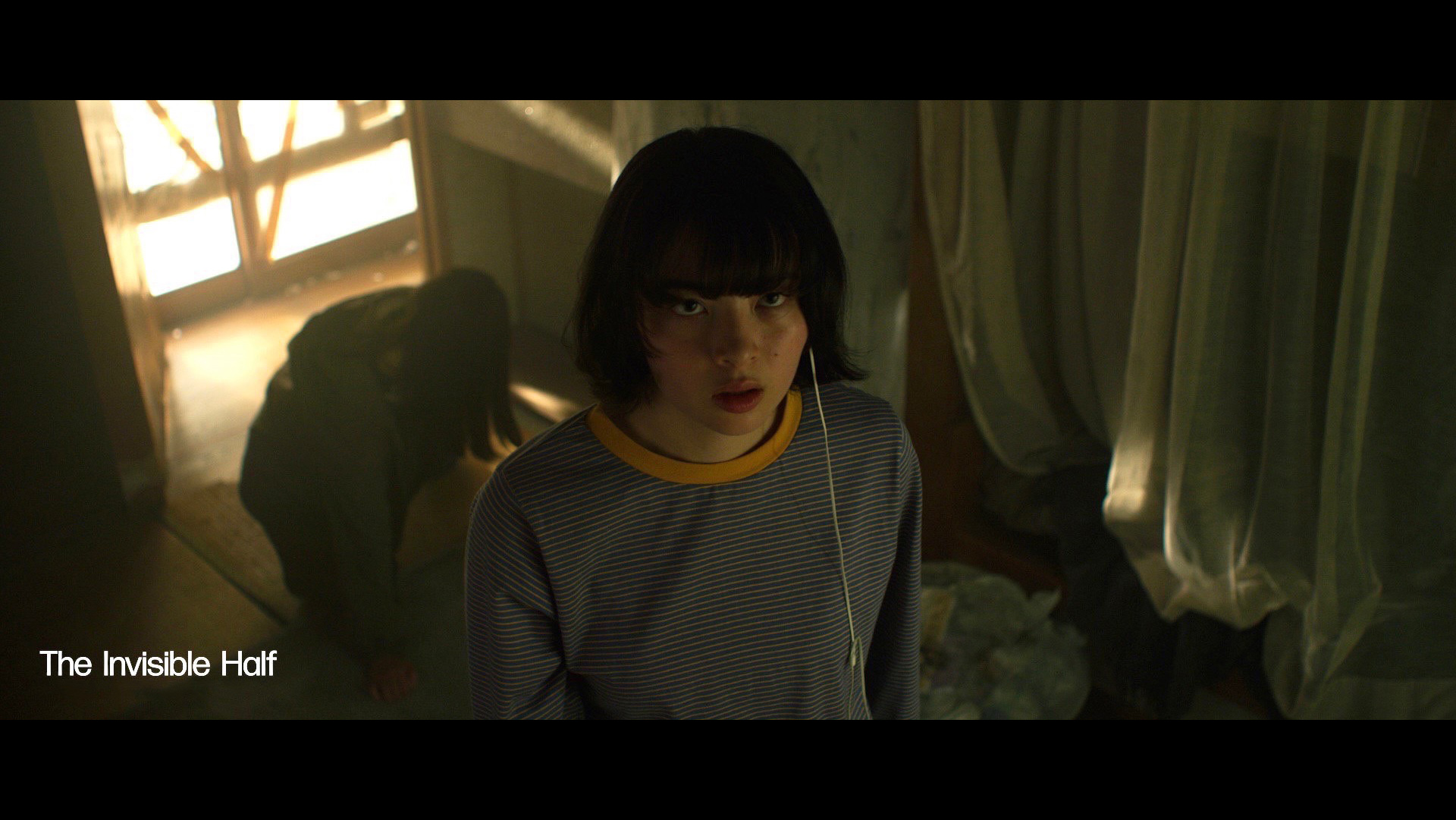
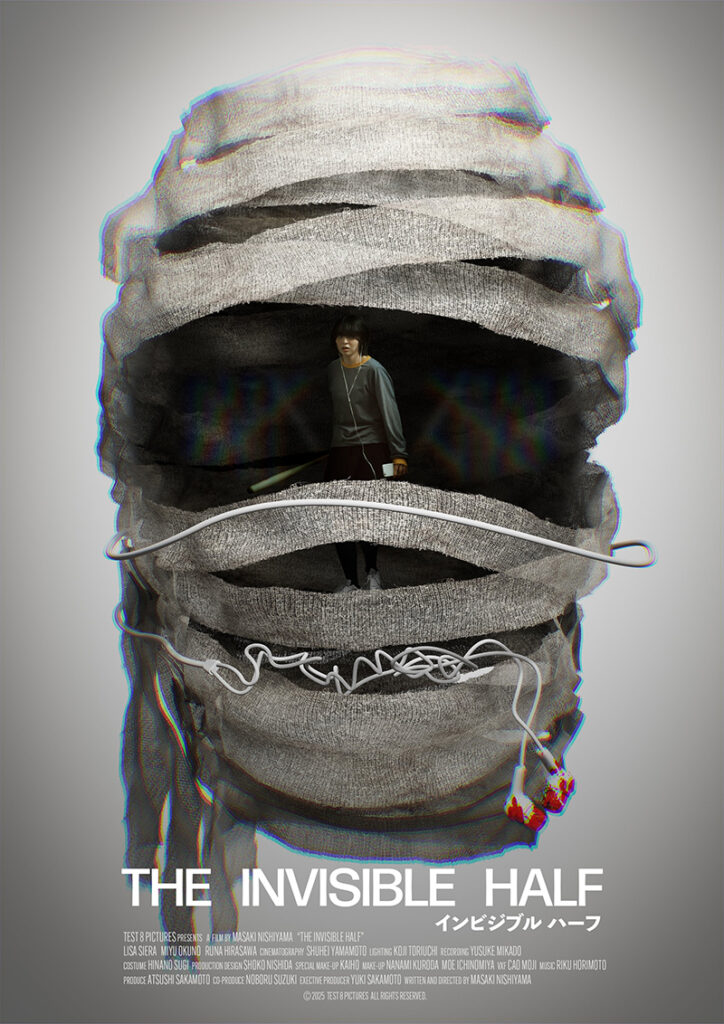
Half-Japanese teen Elena (Lisa Siera) moves to a rural town, feeling out of place. Soon, she realizes she’s being hunted by a monster only visible through her phone and audible through her earphones.
With The Invisible Half (インビジブルハーフ), Masaki Nishiyama offers a film between J-Horror and suspense that draws a parallel between an invisible monster that is part of the character, and the Japanese side that is not perceived in the character who is half European.
Japanese, or “gaijin”?
What is interesting about The Invisible Half lies in its ability to transform an impalpable identity malaise into a terrifying physical threat. By featuring a protagonist torn between her Japanese and English origins, Masaki Nishiyama uses the figure of the half-invisible monster as a distorting mirror of her own existence. This creature isn’t just there to be scary; it embodies the state of “hafu,” where the individual feels perpetually incomplete, a blurred silhouette that is never fully grasped by either of her cultures of belonging.
This incessant stalking by a semi-transparent entity then becomes a metaphor for self-denial. The director brilliantly suggests that what society refuses to see — or what the character tries to hide to fit the mold — inevitably ends up resurfacing to haunt us. The struggle is no longer just external for survival, but becomes a brutal internal confrontation against the erasure of one’s own history. The monster represents this shadow part, this ignored half that demands to be recognized or else it will entirely consume the individual.
Also, by anchoring his story in magical realism, Nishiyama highlights the stifling weight of the social gaze in Japan. By materializing this duality through physical aggression, he takes the debate out of the classic sociological framework to make it visceral. The film demonstrates that as long as identity is not reconciled and accepted in its entirety, it remains a burden, an easy prey for an alienation that, in turn, makes us invisible to the world.
Moreover, the way the other students treat Elena is not so different from that of the monster. The girls are psychologically violent, while the monster is physically so. Another beautiful inversion that links the physical and the immaterial sides. The (physical) girls cause psychological (immaterial) damage, while the (immaterial) monster causes (physical) damage to the body.
Visually strong
Another strong point of the movie is the visual touch. One could say that The Invisible Half is a conceptually rich horror film. This first feature film by Nishiyama has not yet been released in Japan. I feel privileged to have been among the few people who had the opportunity to see it outside of a festival to talk about it for its imminent release in Japan.
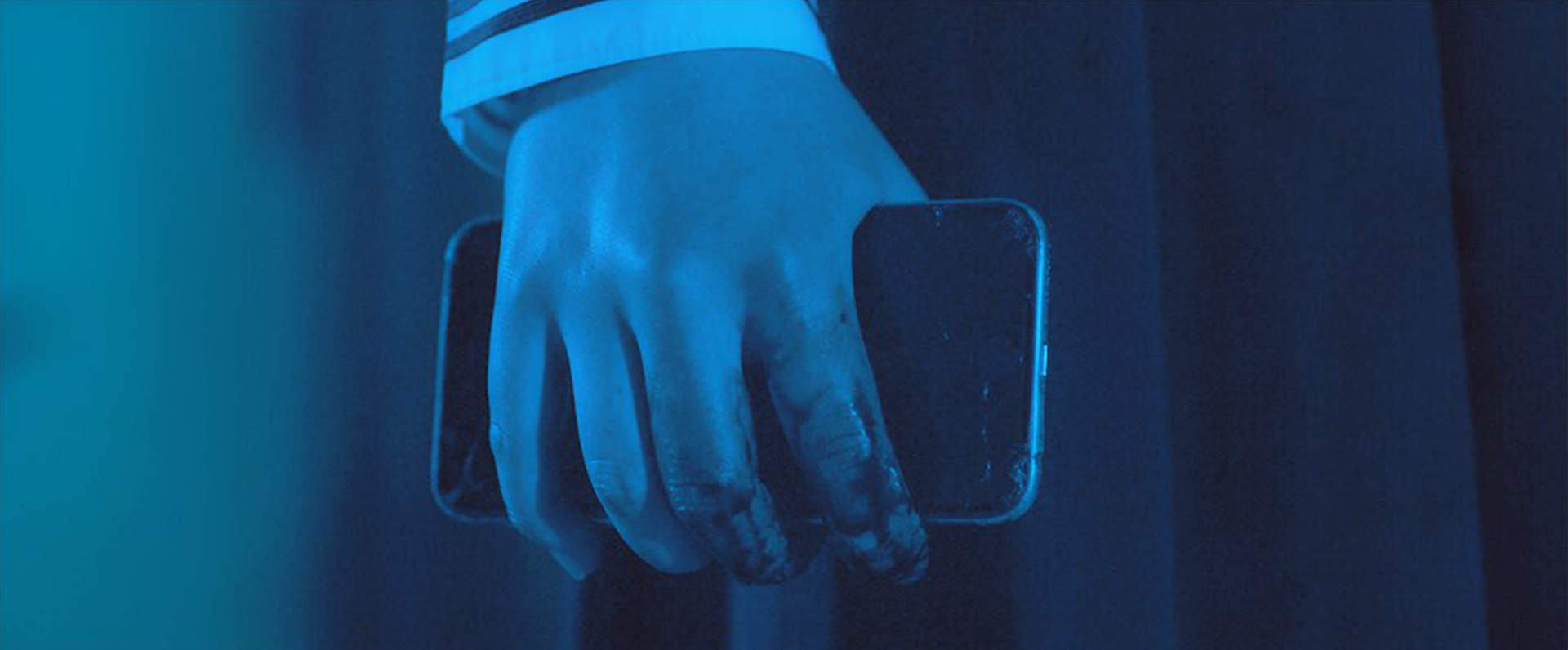
The film stands out for its use of mobile phones and social networks as narrative starting points, transforming familiar technologies into sources of terror. With striking images and a deconstructed soundtrack by Cao Moji (Oscar winner for Godzilla Minus One), it offers a visceral experience.
While we have often seen films that used social networks and phones, Nishiyama does not simply show what we see by using the phone screen or by superimposing social media texts. Instead, he films the images in a usual way, inserting quick shots of the actions taken by the viewer. In this way, he leaves the viewer with the possibility of understanding for themselves.
The result is striking, especially with the unsettling appearance of the monster, and the use of faded sound to represent movements.
A little more…
Without being revolutionary, The Invisible Half brings something new to a genre that must constantly renew itself so as not to fall flat as the slasher did in the United States. Knowing how to use new technologies in a way that brings these changes is effective. But it must be well done. That’s exactly what happens here.
When watching The Invisible Half, you shouldn’t expect to jump. This is not the style found in Japan. It is above all an atmospheric film that reaches the viewer directly at their core. They thus find themselves absorbed. And that’s exactly what we look for when watching a J-Horror film.