“I mean, the protagonist is a flower. What’s not to like?”
BE wakes up in a world she does not recognize. Throughout this mysterious journey, she follows cryptic clues and vestiges of choices yet to be made, bringing her closer to a moment of convergence: the one where she and her future version will merge in the present.
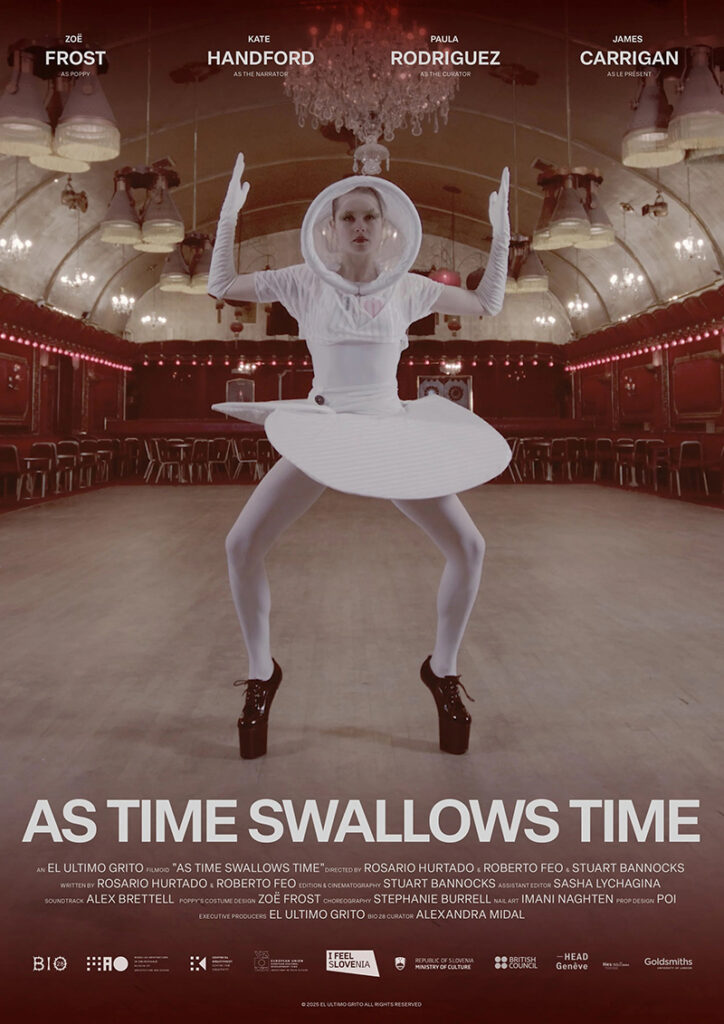
With As Time Swallows Time, Rosario Hurtado, Roberto Feo, and Stuart Bannocks offer a dialogue with the theme of the Ljubljana Biennale, “Do You Speak Flower?”, which explores the historical contexts in which women have been symbolically linked to flowers — figures of fragility, sensuality, and objectification — and how these associations have been reappropriated and subverted. This theme is explored directly, alongside the authors’ speculative journey into time, temporal perception, and post-humanity.
A simple dialogue
This film weaves fragmented narratives into a poetic dialogue between two intimately linked inquiries. These inquiries are carried by two women in a unique dialogue.
The first inquiry is part of the Ljubljana Design Biennale (BIO28), which questions the historical symbolism associating women with flowers – figures of fragility, sensuality, and objectification – and how these associations have been reappropriated and subverted. The directors use the film to show how this analogy has been used by design and art to categorize women. But in As Time Swallows Time, the flower is no longer just a delicate object. It becomes a complex system, sometimes strange or imposing, possessing its own biological strength.
The second part of the film unfolds as a speculative exploration of time and temporal perception, no longer viewed as linear measurements, but as active forces shaping human consciousness and evolution. The film suggests that our relationship with time defines our humanity: by overlaying the slow, almost geological rhythm of plant growth with the fleeting nature of human experience, the directors create a tension where time seems to literally “swallow” the present moment.
Together, these narrative threads compose a profound meditation on transformation and the cyclical nature of existence. The film refuses finality; it prefers the idea of an eternal return or a continuous metamorphosis. This circularity echoes biology — the flower that is born, withers, and is reborn — but also memory, where memories do not fade; they pile up and transform into new layers of consciousness.
Experimental cinema
Constructed through the juxtaposition of narrative fragments rather than dramatic progression, the movie overlays scenes in a way that transforms the spectator into a cartographer. It is no longer about following a story, but about navigating and reconstituting a fragmented temporal and conceptual territory. This structure demands active participation: it is the spectator’s gaze that links the images together, creating a unique and subjective temporality with each viewing.
This structure strangely pushes the viewer into a kind of hibernation where the brain absorbs the images to rearrange them at will. The result is a film that places the viewer in a state of relaxation despite the weight of its themes. It is as if the intellectual side of the film manages itself effortlessly.
A little more…
If you only enjoy blockbuster films, As Time Swallows Time will certainly not be for you. But if you are at all open to being surprised and swept up in a symbolic reflection, you will get your money’s worth.
Cinema is an art. We are not talking about Hollywood, which is an industry, but about real cinema. And art is exactly what this trio of directors offers you. Art is something to be observed, analyzed, and digested.
Beyond its intellectual side, this mid-length feature is an effortless watch. But rest assured that the next day, it will still be on your mind.
As Time Swallows Time is being presented at FIFA on March 14, 2026.
Trailer
Translation by François Grondin with the help of Gemini.